Explained in 30 seconds: generative AI is already in your pocket. Do not wait for the hospital, clinic, health center, or administrative office to formally implement it. With ethical care, especially total anonymization, you can save hours of bureaucratic paperwork while fatigue builds up. The point is not to delegate professional judgment, but to protect it.
The shift ends
The 24-hour shift ends. The coffee is already water. Your feet are heavy, and in front of you are summaries, progress notes, referrals, authorizations, reports, and administrative pending tasks.
This is not futurism or institutional promise. It is using generative AI so bureaucracy does not consume the little clinical energy you have left.
1. The big taboo: is it ethical to use external AI?
Let us be clear: never, under any circumstances, upload sensitive data. No names, IDs, addresses, or identifiable dates.
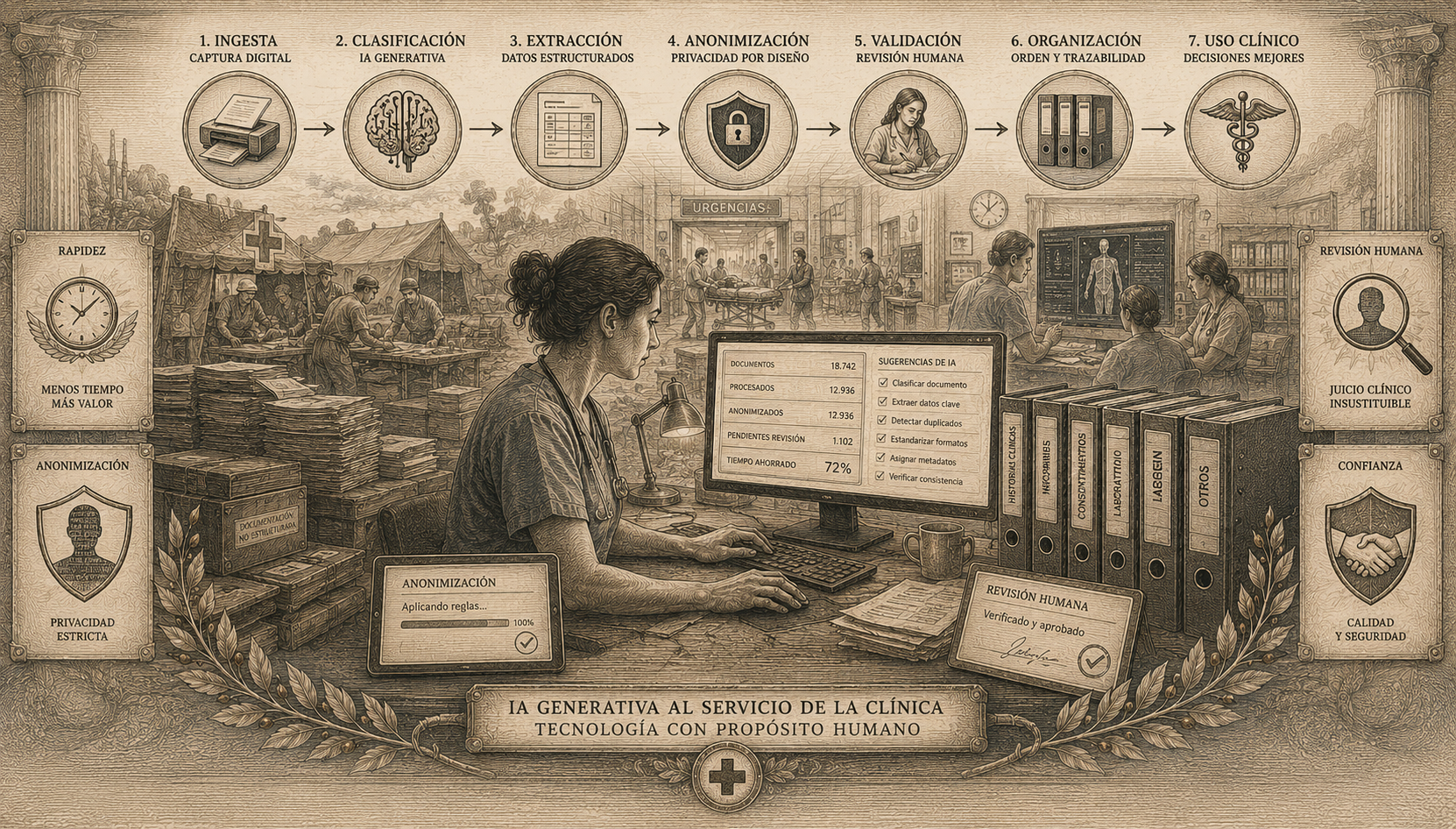
Responsible use of ChatGPT, Claude, and Perplexity is not handing over a clinical record or identifiable case. It is handing over structure, writing criteria, logical order, and control questions.
Golden rule: total anonymization. "Mr. John Smith, 74" becomes "Male patient, 74, with history of hypertension and type 2 diabetes."
2. The anti-burnout workflow
- Voice dictation or quick notes. Use your phone, a local note, or an internal draft and capture raw data, always without identifiers.
- Organize and turn it into functional text. Ask the tool to convert the material into clear, traceable, concise text for care, admissions, auditing, referral, follow-up, or management.
- Human review. AI drafts or reorganizes. You decide, correct, and only then bring it into the institutional system.
The machine saves time. Responsibility remains human.
3. The invisible risk of fatigue
During a shift, a saturated admission desk, or an overloaded administrative area, fatigue creates doubt. You reread the same paragraph five times. That is not lack of knowledge. It is cognitive overload.
Used well, AI does not decide for you. It reduces initial friction and gives you a stable structure on which to validate facts, criteria, and context.
4. ChatGPT, Claude, and Perplexity
ChatGPT can turn messy notes into clear drafts, pending-task lists, and internal messages. Claude is often useful for long texts, institutional tone, and coherence. Perplexity can help explore public information and locate sources; it does not replace local rules or institutional instructions.
Conclusion
Do not wait for the system to be ready. AI is already in your pocket. Used with judgment, it does not replace your judgment: it protects it when fatigue starts to erode it. It is a cognitive prosthesis, not a clinical, administrative, or institutional authority.
Taking care of how we work when exhausted is also patient safety, team safety, and process safety.
Learn to use it
If you want to learn how to use these tools with judgment, safety, and real application in healthcare teams, contact the Nexus Humanum Classroom.
Shared reading
Commentarii
This space is intended for brief contributions, questions, or critical readings about the article. For now, every submitted text is subject to editorial review before any publication.