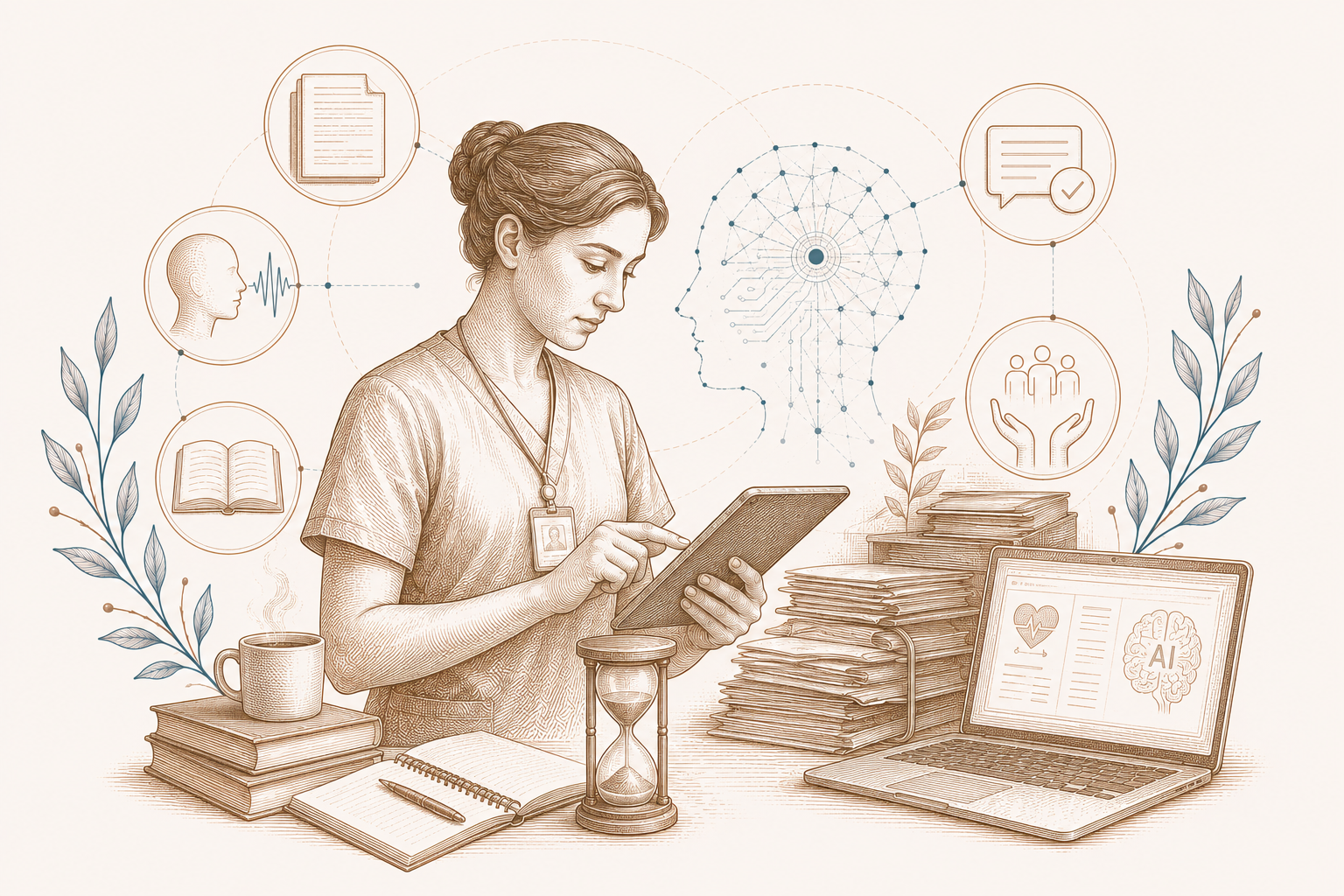
There is a scene repeated in almost every healthcare service in Latin America: a nurse reviewing records in a hurry, a technician finishing delayed orders, a family member waiting for an answer, a door opening again.
Then comes the phrase many know too well: "There is not enough time."
The problem is often not lack of skill or commitment. It is that a huge part of professional energy is consumed by repetitive, administrative, or fragmented tasks.
What many imagine and what is really happening
When people hear artificial intelligence, they still imagine something far away: programmers, engineers, huge hospitals full of screens. But many useful tools are already here.
A nursing professional can dictate a progress note and turn it into text, summarize a long protocol, transform difficult documents into patient education material, or prepare an internal training activity much faster.
The difference between using AI and working with AI
At Nexus Humanum we do not teach only how to talk to a machine. We aim to turn AI into a professional assistant: giving clear instructions, detecting errors, recognizing convincing but incorrect answers, and adapting use to real healthcare.
Experience remains human
An algorithm can organize information, but it does not detect fear in a patient's eyes, hold families, or build trust. Clinical experience remains human. That is exactly why technology matters: to free time and let the human return to the center.
If you work in healthcare and feel curiosity or distrust about AI, this space was probably built for you. We want to hear real experiences: what repetitive task consumes your time? What daily problem has nobody solved yet?
Nexus Classroom contact
Nexus Humanum
The human interface between AI and real clinical practice.
Sine fumo et nugis.
Shared reading
Commentarii
This space is intended for brief contributions, questions, or critical readings about the article. For now, every submitted text is subject to editorial review before any publication.